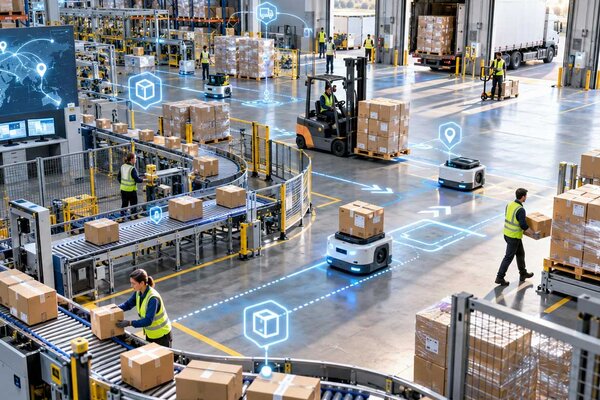
Why warehouse performance is not held back by technology, but by management style
2026-06-22 | 10 min Logistics and Manufacturing
Warehouse performance is often held back not by a lack of technology, but by sluggish workflow, bottlenecks, queues, and poor process coordination. Find out where hidden limits arise in warehouses and warehouse processes.

Most warehouses today are not held back by a lack of technology
Warehouse performance does not mean only the number of orders picked, the speed of one technology, or the productivity of a particular warehouse zone. In practice, it is about the warehouse's ability to process orders smoothly, use available capacity, minimize downtime, and maintain a stable flow of work between receiving, replenishment, picking, consolidation, and dispatch.
In recent years, warehouses have undergone a significant technological transformation. Companies have invested in warehouse systems, automation, conveyor routes, AS/RS technologies, picking solutions, mobile terminals, data analytics, and various layers of process digitalization.
From an infrastructure perspective, many operations are more technologically advanced than ever before. Even so, the same scenario often repeats itself in practice:
- throughput stagnates,
- workload fluctuates between zones,
- waiting queues arise,
- operators and technologies have unused capacity,
- automation does not achieve the expected performance,
- supervisors must constantly adjust priorities manually during the shift.
And this is where the paradox of today's logistics arises. In a large share of warehouses, the problem today is no longer a lack of technology. The problem is the way the individual parts of the operation communicate, respond, and coordinate with each other.
The modern warehouse no longer functions as a series of isolated operations. It functions as a connected flow of work, where the performance of one part directly influences the behavior of the entire operation. That is why bottlenecks often do not arise in the performance of the technology itself, but in the logic of managing the flow of work among people, orders, zones, and automated subsystems.
How to tell that a warehouse is losing performance
Low warehouse performance does not have to appear as one major problem. It is often a set of smaller symptoms that do not seem dramatic on their own, but together significantly slow down the entire operation.
Typical signs are:
- orders wait between individual processes,
- picking is productive, but dispatch cannot keep up,
- replenishment arrives late and slows down picking,
- conveyor systems wait for the next zone to be released,
- automation has performance reserves, but the warehouse's overall throughput does not grow,
- operators wait for further tasks,
- overload occurs in one zone, while another zone has significant reserve capacity,
- supervisors often change priorities manually,
- local KPIs look good, but customer priorities are under pressure.
From the perspective of individual processes, everything may look relatively correct. Picking is running. Conveyors are working. Automation is operating. Dispatch is processing orders. Nevertheless, the warehouse as a whole is not achieving the expected performance. The reason is simple: a warehouse does not lose performance only during the work itself. It often loses it through waiting, synchronization, priority shifting, and downtime between processes.
Local optimization does not yet mean higher warehouse performance
For many years, traditional warehouse management was based on optimizing individual processes. That is logical. Every warehouse needs to effectively manage:
- picking,
- replenishment,
- dispatch,
- allocation of storage locations,
- assignment of work tasks,
- operators' workflow,
- movement of goods between zones.
Each of these processes can be optimized very well. A warehouse worker can have an efficient route. Replenishment can run according to rules. An AS/RS system can achieve high technical performance. Dispatch can have a clearly defined procedure.
However, that does not yet mean that the warehouse as a whole operates efficiently. The modern warehouse is a network of dependencies. Picking affects dispatch. Replenishment affects picking. The state of automation affects operators' workload. Consolidation capacity affects the smoothness of dispatch. And every delay or local overload is transmitted further into the entire flow of work.
This is where the fundamental difference arises between process optimization and warehouse performance optimization. A locally efficient process does not yet mean an efficient warehouse. If one zone is working at maximum, the second is waiting, the third is creating a queue of further tasks, and the fourth does not have enough work, the warehouse's overall throughput will not increase. On the contrary, it may stagnate even though each part individually meets its KPIs. Warehouse performance must therefore be assessed by how smoothly the individual parts cooperate as one system.

Where hidden bottlenecks arise in the warehouse
A bottleneck in a warehouse does not always have to be visible as a failure, a lack of people, or a technology outage. In modern operations, it often arises between processes.
Typical example: The picking zone works quickly and meets its KPIs. Orders, however, then wait for consolidation or dispatch. From the perspective of picking, the process is efficient, but from the customer's perspective the order still has not left. The problem is therefore not in picking itself, but in the coordination between picking, consolidation, and dispatch.
A similar situation can arise elsewhere as well:
- replenishment cannot keep up with replenishing picking locations,
- automated technology waits for subsequent processes,
- the conveyor route fills up because of a bottleneck in sorting,
- urgent orders disrupt batches already in progress,
- warehouse workers wait for further tasks even though several work assignments have already been created.
Such bottlenecks are dangerous precisely because they are not usually visible in traditional process KPIs. Individual zones may show performance, but the overall flow of work slows down. Warehouse performance is therefore often reduced not by one major outage, but by hundreds of small downtimes that accumulate across the entire operation.
When the warehouse starts working in queues
One of the least visible, but most significant, problems in modern warehouses is the way work queues arise. The traditional warehouse management model is often based on:
- batch processing,
- sequential assignment of work tasks,
- planning operations in batches,
- fixedly defined workflows.
For a long time, this approach made sense. It enabled picking to be organized, routes to be optimized, and process discipline to be maintained. In an environment with a relatively stable flow of orders, it worked very well.
However, the modern warehouse operates more dynamically. Orders arrive continuously, priorities change during the day, the dispatch priorities of individual customers differ, and the availability of people and technologies fluctuates. In such an environment, it is not only work tasks that arise. Waiting queues also arise between them.
Operators wait for work assignments. Picking waits for replenishment. Dispatch waits for consolidation. Conveyors wait for the next zone to be released. Automated subsystems wait for confirmation of the next step.
At the KPI level, everything may look relatively fine. Processes are running. People are working. Technologies are functioning. Nevertheless, warehouse throughput is stagnating. The reason is that the warehouse is not experiencing one major outage. It is experiencing many short delays that gradually add up to a noticeable loss of performance. The more complex the warehouse, the more its performance depends on the smoothness of the flow of work, not on the maximum performance of individual operations.
The warehouse is changing faster than traditional management can respond
One of the biggest changes in today's logistics is the speed at which the warehouse operation itself changes. During a single shift, the following may change several times:
- order priority,
- availability of operators,
- utilization of picking zones,
- status of automated technologies,
- dispatch capacity,
- number of urgent orders,
- distribution of workload between zones.
The warehouse no longer operates according to one stable plan. It operates as a system whose conditions change in real time.
This is where the limit of traditional management becomes apparent. A warehouse system can respond very well to defined events: create a work assignment, change a priority, redirect the workflow, or reschedule a batch. The problem is that a modern warehouse does not need only a response to change. It needs continuous decision-making together with the change.
If the system cannot dynamically coordinate workload across the warehouse, a typical operational mode emerges:
- manual interventions by supervisors,
- rescheduling during the shift,
- priority skipping of allocated tasks,
- firefighting instead of management,
- escalations between departments.
In many warehouses, experienced operators and shift leaders stand in for what the system cannot do continuously on its own. The warehouse has modern technologies, enough data, and automated workflows, yet it still operates in permanent operational tension. Precisely because the operation changes faster than the traditional management method can continuously balance it. This shift is closely related to the fact that warehouse software management today has to adapt to a more dynamic flow of orders, capacities, and priorities than in the past.
When batching and wave picking start slowing down the flow of work
For many years, wave picking was one of the most effective principles for managing warehouse operations. In an environment with a stable flow of orders, it enabled:
- effective grouping of tasks,
- optimization of picking routes,
- better use of labor,
- greater control over dispatch.
The logic was simple: instead of continuously processing individual orders, a batch, or wave, is created and then processed as one optimized whole. With stable volumes and a predictable order profile, this model worked very well. Today, however, warehouses operate in a different mode.
The following enter a single operation:
- omnichannel distribution,
- high variability of e-commerce orders,
- dynamic dispatch priorities,
- urgent orders,
- unpredictable priorities during the day.
In such an environment, batch logic starts to feel less natural. The warehouse no longer works in regular rhythms. It works continuously. The result is situations familiar to most larger operations:
- orders wait for the next picking wave,
- waves in progress are interrupted because of priority orders,
- supervisors manually break up batch logic,
- bottlenecks arise in picking zones,
- workload accumulates in short time windows.
Wave picking itself can be very well optimized. Routes are efficient, work tasks are allocated correctly, and operators are productive. Nevertheless, the overall warehouse flow stagnates. The reason is fundamental: wave picking optimizes the batch, not the continuous flow of work.
The more dynamic the operation, the more this model comes into conflict with the reality of the warehouse. Today's logistics has less and less need to optimize individual waves. It needs to coordinate the flow of orders, people, and technologies in real time.
In e-commerce logistics, this problem becomes even more pronounced because orders have higher variability, shorter delivery windows, and less room for delays between processes.

Want to find out where your warehouse is losing performance?
Warehouse performance is often held back not by one technology or one isolated process, but by the many small downtimes, waiting areas, and unbalanced capacities in between. We can help you map your workflow, identify bottlenecks, and see where optimization has the greatest impact.
Find out moreWhy warehouse automation by itself does not guarantee higher performance
In logistics, a simple rule applied for a long time: more automation means higher warehouse performance. To a large extent, this still holds true. Automation technologies such as AS/RS systems, shuttle solutions, conveyors, or automated picking can dramatically increase both the capacity and accuracy of operations.
Nevertheless, many automated warehouses today encounter a paradoxical problem: technologies have performance reserves, but the warehouse's overall throughput stagnates. The reason is often not the technology itself. The problem arises in the way the individual subsystems are coordinated.
In many operations, automation works as a series of relatively isolated units:
- AS/RS optimizes its own performance,
- the shuttle system monitors its own KPIs,
- conveyors work according to local rules,
- the warehouse system assigns tasks according to a predefined workflow.
Each part of the warehouse can therefore function efficiently on its own. However, that does not yet mean that the entire flow of work functions efficiently. Typical operational situations are:
- the AS/RS system waits for previous processes,
- the shuttle is overloaded while other zones have reserve capacity,
- the conveyor route stops because of a bottleneck in consolidation,
- a warehouse worker has no assigned task even though the warehouse has a queue of orders.
At the level of individual technologies, everything may look fine. Local KPIs are met, equipment functions, and tasks are carried out. Nevertheless, warehouse performance does not grow. Today's warehouse is a coordinated flow of dependencies between processes.
The higher the level of automation, the more important the synchronization of workload, priorities, available capacities, order flows, and responses to change in real time becomes. Therefore, it is not enough simply to deploy automated subsystems. They must be part of broader intelligent automation in logistics that connects technologies, orders, and capacities into one managed flow.
Warehouse performance depends on coordination, not on isolated KPIs
One reason why warehouses do not achieve the expected performance is the way it is measured. Many operations track the performance of individual processes, but less consistently track how these processes cooperate as a whole.
If only picking performance is tracked, a problem in dispatch may be missed. If only automation performance is tracked, a problem in replenishment may be missed. If only people's utilization is tracked, a problem at waiting points between tasks may be missed.
Warehouse performance should therefore also be evaluated through questions such as:
- where downtime arises,
- which zones are regularly overloaded,
- where unprocessed orders accumulate,
- where operators or technologies wait for the next step,
- which processes require manual interventions,
- where priorities change during the shift,
- which local KPIs are met, but overall throughput does not grow.
True warehouse performance optimization does not start with the question of which technology is the fastest. It starts with the question of how smoothly the whole system cooperates. Warehouse performance therefore cannot be separated from the economics of the operation either. Micro-downtimes, duplications, poor timing, and unbalanced capacities directly affect the overall profitability of the warehouse.

This does not mean that technology is not important
Saying that warehouse performance is not hindered by technology does not mean that technology is not important. Without a quality warehouse system, automation, data, and process discipline, a modern warehouse could not function at the required speed or accuracy.
The point lies elsewhere.
The more technologies a warehouse uses, the more important their coordination becomes. Warehouse performance depends not only on how quickly each part works separately, but on how smoothly they cooperate as one system. Technology creates capacity. Management determines whether this capacity is actually used.
That is why the difference between WMS and WES systems becomes important especially when a warehouse needs not only to record and manage processes, but also to coordinate the flow of work, priorities, and capacities in dynamic operations.
How to improve warehouse performance without another isolated technology
Improving warehouse performance does not always have to mean another investment in new technology. In many cases, a better understanding of the flow of work and the removal of hidden bottlenecks has a greater effect.
The first step should be an analysis of how the warehouse actually functions during the shift:
- where downtime arises,
- where processes become overloaded,
- which zones wait for other processes,
- where priorities change often,
- where supervisors intervene manually,
- where automation waits for a person or another subsystem,
- where customer orders spend the most time without movement.
Then it is possible to look for measures that improve not only one process, but the entire flow of work:
- more dynamic priority management,
- better load balancing,
- more precise timing of replenishment,
- smoother connection between picking and dispatch,
- better use of automated subsystems,
- reduction of manual interventions during the shift,
- continuous evaluation of capacities in real time.
High warehouse performance does not arise because every part runs at maximum. It arises because the whole system works smoothly, predictably, and with minimal waiting between processes.
The right warehouse performance lies in real-time decision-making
Warehouse automation will continue in the coming years across practically all logistics segments. More powerful AS/RS systems, smarter robotic technologies, more advanced picking solutions, and more data tools will be added.
Physical infrastructure itself, however, increasingly represents less of the main limit of warehouse performance.
Competitive advantage is shifting to the ability to coordinate the flow of work in real time. To the ability to continuously balance capacities, priorities, workload, and available technologies across the entire operation.
The more complex a warehouse is, the less the maximum performance of individual technologies matters. And the more the quality of coordination between them matters.
In the past, the goal was to maximize the performance of individual operations: faster picking, a more powerful conveyor, a higher number of tasks per hour. Today, it is increasingly clear that the decisive factor is the ability to maintain a stable and smooth flow of work across the entire system, even amid the constantly changing reality of operations.
With the growing amount of data and real-time decisions, artificial intelligence in logistics will also play an increasingly important role, especially in evaluating ongoing processes, predicting workload, and supporting decision-making in a dynamic environment.
Today's warehouse is usually no longer hindered by a lack of technology. It is hindered by the way it coordinates the complexity of its own operations.
Warehouse performance and warehouse process optimization
What is warehouse performance?
Warehouse performance is the ability of a warehouse to process orders, inventory, and logistics operations in the required time, quality, and capacity. It is not just about picking speed or the performance of a single technology, but about the smoothness of the entire workflow.
How to increase warehouse performance?
Warehouse performance can be increased by better coordination of processes, elimination of bottlenecks, load balancing, reduction of downtime, more accurate priority management and better use of available technologies.
Why doesn’t warehouse automation guarantee higher throughput?
Automation increases the throughput of individual operations, but it alone doesn’t guarantee smooth workflow. If automated subsystems aren’t well coordinated with people, orders, and shipping capabilities, overall warehouse throughput can stagnate.
What are warehouse bottlenecks?
A bottleneck is a part of a process that limits the performance of the entire warehouse. It could be a congested zone, slow consolidation, insufficient replenishment, a pending shipment, or a process that cannot respond to changes in real time.
Why is local optimization not enough?
A locally optimized process may work efficiently on its own, but it can still slow down the warehouse as a whole. Warehouse performance depends on how well individual processes work together, not just how fast each one works in isolation.
How to find out where your warehouse is losing performance?
It is best to analyze the workflow between processes: where waiting points arise, where the load accumulates, where manual interventions occur, and where technology or operators wait for the next step.