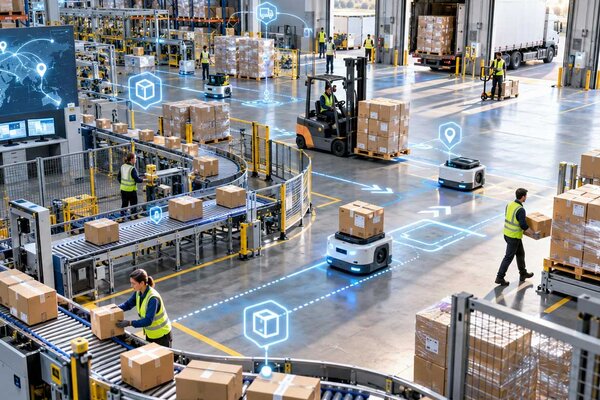
Why an automated warehouse needs real-time process control
2026-07-16 | 14 min Logistics and Manufacturing
Automation can significantly boost the performance of individual warehouse sections. However, a faster conveyor, a higher-capacity sorter, or a more efficient shuttle system does not automatically mean the entire warehouse is operating optimally.

Today's logistics operations must continuously respond to changing order priorities, workforce availability, equipment utilization, emerging bottlenecks, and approaching dispatch deadlines. A plan created at the beginning of a shift may therefore no longer produce the best result several hours later. This is precisely the problem addressed by the Warehouse Execution System – WES.
WES is a software layer for coordinating and optimizing warehouse operations in real time. It connects process management in the WMS with the control of automated technologies in the WCS and continuously aligns orders, tasks, people, capacities, and equipment. WES does not replace the WMS or WCS. It adds the ability to manage the warehouse as a single dynamic flow of work.
Technology performance alone does not guarantee the performance of the entire warehouse
Imagine a distribution center where picking can prepare 900 orders per hour, while the packing and dispatch zone can process only 600. The WMS may correctly release tasks according to the prepared plan. The WCS may flawlessly control conveyors, sorters, and other equipment. Even so, a queue of work-in-progress orders begins to build up before dispatch. Picking is operating efficiently. Automation is working correctly. However, the overall warehouse flow is not balanced.
The results may include:
- overloaded workstations,
- a growing volume of work-in-progress orders,
- unused capacity in other parts of the warehouse,
- manual changes to priorities,
- frequent operational interventions,
- delayed dispatches,
- problems meeting delivery commitments.
Such situations illustrate the difference between optimizing individual processes and optimizing the entire operation. Automation increases the performance of specific parts of the warehouse. Orchestration ensures that these parts function as one coordinated system.
How warehouse management has evolved
Each generation of warehouse systems emerged in response to a different type of operational challenge. The WMS brought control over inventory and processes. The WCS made it possible to control automated equipment. WES arose from the need to coordinate the entire flow of work in real time.

The WMS introduced control over warehouse processes
The first major challenge for modern warehouses was to gain precise control over inventory and material movement.
Companies needed to:
- know where specific goods were located,
- record inventory movements,
- manage receiving, put-away, and dispatch,
- standardize work procedures,
- reduce the number of manual errors,
- ensure material traceability,
- assign and monitor warehouse tasks.
The Warehouse Management System – WMS was created to address these needs. The WMS determines what must be done in the warehouse. It manages inventory, orders, process rules, and tasks related to receiving, put-away, picking, replenishment, and dispatch.
This model worked extremely effectively in an environment where a significant share of operations could be planned in advance. Orders were processed in batches, picking was organized into waves, and capacity could be planned based on a relatively stable workload.
Decisions were made primarily before the process itself was carried out:
- the system created a plan,
- assigned tasks,
- the operation carried them out according to the configured rules.
The WMS thus became the fundamental management layer of the modern warehouse.
The WCS made it possible to control automated technologies
As order volumes increased, warehouses began to encounter the physical limits of manual operations. The following technologies were therefore gradually introduced into operations:
- conveyor systems,
- sorters,
- AS/RS systems,
- shuttle technologies,
- automated picking solutions,
- robotic workstations,
- high-speed conveyor lines.
Automation increased warehouse throughput, shortened operation processing times, and made it possible to handle higher volumes without a linear increase in the number of workers. At the same time, however, it created the need to control physical equipment in real time.
The WMS was not designed for:
- communication with PLCs,
- routing material in milliseconds,
- synchronizing conveyors and sorters,
- responding immediately to equipment status,
- direct control of automated subsystems.
This led to the creation of the Warehouse Control System – WCS.
The WCS performs physical operations and coordinates technological equipment. For example, it decides which route a tote should follow, when a particular conveyor should be activated, or where a sorter should direct a shipment. Its main task is to ensure the smooth and reliable operation of automation.
However, the WCS typically optimizes equipment or specific technology systems. It may not have sufficient context to optimize all warehouse orders, processes, and capacities as a single system.
The WES coordinates the entire flow of work
Today's warehouse needs to know more than just what must be done and how individual pieces of equipment should operate.
It must continuously decide:
- which order is currently the most important,
- which tasks should be released,
- where a bottleneck is emerging,
- which workstation is overloaded,
- where unused capacity remains,
- how to respond to a technology failure,
- how to align people and automation,
- how to ensure dispatch in accordance with agreed delivery commitments.
This is the role of the Warehouse Execution System.
WES treats the warehouse as a dynamic system of interconnected processes. It does not optimize only an isolated piece of equipment or a single workflow. It continuously evaluates the state of the entire operation and adjusts the sequence, timing, and allocation of work according to current conditions.
WMS, WCS, and WES: what is the difference between them?
The individual systems are not direct competitors. Each addresses a different layer of warehouse management.
| System | Main role | Typical areas of control |
| WMS | Inventory and warehouse process management | Receiving, put-away, picking, replenishment, dispatch, inventory records |
| WCS | Direct control of automated equipment | Conveyors, sorters, AS/RS, shuttle systems, PLCs, and material routing |
| WES | Orchestration of work, capacity, and orders | Priorities, task allocation, workload balancing, SLAs, people, and automation |
In simple terms:
- The WMS knows what needs to be done.
- The WCS knows how the equipment should operate.
- The WES decides what should be done right now, in what order, and using which resources.
Why a static plan is no longer sufficient in today's warehouse
Traditional warehouse management assumed that most work could be prepared efficiently in advance. Today's operations, however, are affected by high variability:
- a changing order mix,
- shorter delivery lead times,
- omnichannel distribution,
- different levels of customer delivery commitments,
- a combination of manual and automated operations,
- fluctuating workforce availability,
- equipment failures and downtime,
- unexpected changes in workload,
- express and priority orders.
During a single shift, picking utilization, automation status, and packing workstation capacity may all change. If the system continues according to the original plan, it may create additional workload precisely in the part of the warehouse that is already falling behind. The WES therefore continuously reassesses the situation and adjusts the flow of work according to the current state.
For example, it may:
- limit the release of orders into an overloaded zone,
- increase the priority of shipments approaching their dispatch deadline,
- move part of the work to available workstations,
- change the sequence of picking tasks,
- adapt the workload to workforce availability,
- respond to a technology failure,
- align picking speed with packing and dispatch capacity.
Instead of blindly executing the original plan, a continuous decision-making process is created.

Do you want to find out where your warehouse is losing performance?
Warehouse performance is often hampered not by a single technology or isolated process, but by numerous instances of downtime, waiting periods, and capacity imbalances between them. We will help you map your workflow, identify bottlenecks, and determine where optimization will have the greatest impact.
Find out moreWhat problems does warehouse process orchestration solve?
Dynamic order release
The WES does not have to release all orders at once simply because they are ready for processing. It takes into account the available capacity of downstream workstations and creates a volume of work in progress that the warehouse can actually process. This reduces queues and prevents individual zones from becoming overloaded.
Prioritization according to agreed delivery commitments
Not all orders are equally urgent. The WES can continuously evaluate:
- the planned dispatch time,
- the customer type,
- the transport service,
- the order completion status,
- the availability of goods,
- the current warehouse workload.
Based on this information, it adjusts the sequence of tasks so that the warehouse optimizes not only the number of items processed, but also its actual ability to meet customer commitments.
Bottleneck management
A bottleneck can shift during a single shift. Receiving may be the most heavily loaded area in the morning. Later, it may be picking. Before the dispatch cut-off, the bottleneck may move to packing or sorting. WES continuously identifies these changes and adjusts the flow of work so that the problem does not worsen further.
Coordination of people and automation
Many warehouses are not fully automated. They combine manual picking, conveyor systems, robotics, automated stacker cranes, and manual packing workstations. Warehouse performance therefore depends on coordinating different types of resources.
The WES can align:
- workforce availability,
- the performance of automated equipment,
- the number of open workstations,
- the current order volume,
- the required throughput level,
- dispatch priorities.
The result is not the maximum utilization of every resource at any cost, but the optimal performance of the entire process.
Response to failures and unplanned changes
When equipment or a workstation fails, simply informing the operator is not enough. It is necessary to decide:
- which tasks should be stopped,
- which orders can be rerouted,
- which priorities need to be changed,
- where replacement capacity is available,
- how to minimize the impact on dispatch.
The WES can support or automate these decisions according to configured rules and the current state of the operation.
When does a warehouse need a WES?
Not every warehouse needs a separate WES layer. In a simpler operation, a high-quality WMS supplemented by the control of specific technologies may be sufficient. The importance of a WES increases with the complexity of warehouse management.
Does a WES make sense for your warehouse?
| Question | YES / NO |
| Does the warehouse use multiple types of automation, such as conveyors, sorters, AS/RS, shuttle systems, or robots? | YES / NO |
| Does the operation combine manual work, robots, and automated equipment? | YES / NO |
| Does the warehouse process orders with different priorities, dispatch deadlines, or delivery commitments? | YES / NO |
| Does the volume or structure of orders change significantly during the day? | YES / NO |
| Do workers or shift supervisors often have to change priorities manually and reschedule tasks? | YES / NO |
| Do queues, downtime, or bottlenecks occur regularly in the operation? | YES / NO |
| Does the high performance of one zone overload another part of the warehouse? | YES / NO |
| Does the automation fail to achieve the expected utilization rate or throughput? | YES / NO |
| Is the warehouse unable to respond quickly enough to equipment failures or capacity changes? | YES / NO |
| Is warehouse performance highly dependent on manual interventions and the experience of specific workers? | YES / NO |
| Does the warehouse have problems meeting agreed dispatch deadlines or customer delivery commitments? | YES / NO |
| Is it impossible to handle further volume growth simply by increasing the number of workers? | YES / NO |
Evaluation
| Number of YES answers | Recommendation |
| 0–2 | A separate WES is probably not yet necessary. Current needs may be covered by a high-quality WMS and the control of individual technologies. |
| 3–5 | A WES may be beneficial for your operation. It is recommended to examine the main bottlenecks, the task allocation method, and capacity utilization. |
| 6 or more | A WES makes sense for your warehouse. The operation probably needs dynamic, real-time coordination of orders, people, capacities, and automation. |
If you answered YES to several questions, your warehouse probably needs not only more powerful automation, but better orchestration of the entire flow of work.
Another important sign is a situation in which the warehouse achieves good local KPIs but still has problems with overall order processing time, meeting delivery commitments, or operational stability.

The WES does not replace the WMS or WCS
WES is sometimes presented as a new generation of system intended to replace existing solutions. In practice, however, its role is more about connecting and coordinating them.
| Area of comparison | WMS – Warehouse Management System | WCS – Warehouse Control System | WES – Warehouse Execution System |
| Main role | Manages inventory, orders, and warehouse processes | Controls automated equipment and the physical movement of material | Coordinates the entire flow of work across the warehouse in real time |
| Primary focus | Process control and data accuracy | Technology execution and equipment synchronization | Dynamic orchestration of orders, people, capacities, and automation |
| Inventory | Inventory records, accuracy control, and location management | Ensures the physical movement of handling units according to instructions | Takes inventory availability into account when determining task sequence and timing |
| Warehouse processes | Manages receiving, put-away, picking, replenishment, and dispatch | Performs the technological operations required to carry out processes | Continuously coordinates processes according to current workload and priorities |
| Traceability | Ensures the traceability of material, inventory, and completed operations | Records the status and movement of material within technological subsystems | Connects the operational context of tasks, orders, and resources while they are being executed |
| Order management | Records orders, defines process steps, and creates warehouse tasks | Performs the physical movements required to process orders | Determines which orders and tasks should be performed first |
| Process rules | Applies defined rules, strategies, and work procedures | Controls equipment according to technical and safety rules | Dynamically adapts decisions to the current situation in the warehouse |
| Warehouse tasks | Creates, assigns, and records tasks | Carries out tasks through automated equipment | Changes task sequence, timing, and allocation according to operational developments |
| Equipment control | Generally does not control equipment directly | Directly controls conveyors, sorters, AS/RS, shuttle systems, and other technologies | Decides how and when technological resources should be used |
| Communication with PLCs | Usually takes place indirectly through an integration or control layer | Provides direct communication with PLCs and technological subsystems | Uses equipment status information in operational decision-making |
| Material routing | Determines the process destination or warehouse location | Controls the specific physical route of material in real time | Takes capacities, priorities, and bottlenecks into account when coordinating flow |
| Automation synchronization | Provides process instructions and requirements | Synchronizes individual devices and technology systems | Aligns automation performance with orders, people, and downstream processes |
| Technology safety and continuity | Defines the process framework and permissions | Ensures safe, stable, and smooth equipment operation | Responds to constraints or failures by changing priorities and the flow of work |
| Dynamic decision-making | Makes decisions primarily according to predefined rules and plans | Responds to the immediate state of the technology | Continuously reassesses the state of the entire operation and adjusts the next steps |
| Coordination of orders and resources | Manages orders and creates work requirements | Coordinates the equipment needed for their physical execution | Aligns orders, workers, workstations, equipment, and available capacities |
| Priority management | Assigns priorities according to configured business and process rules | Executes accepted requests according to technological logic | Continuously changes priorities according to delivery commitments, capacities, and the current warehouse status |
| Capacity balancing | Plans and allocates work according to available data | Optimizes the performance of specific equipment or technology zones | Balances the workload between picking, automation, packing, and dispatch |
| Response to bottlenecks | Provides data and process options for addressing them | Responds to local technological constraints | Identifies emerging bottlenecks and adjusts the flow of work across the warehouse |
| Work-flow optimization | Optimizes individual warehouse processes | Optimizes material movement and equipment utilization | Optimizes the behavior of the entire warehouse as one interconnected system |
| Type of decision-making | Process-based and transactional | Technical and operational | Orchestration and real-time optimization |
| Resulting benefit | Inventory accuracy, process control, and traceability | Reliable automation performance and smooth material flow | Higher throughput, better capacity utilization, and more consistent fulfillment of delivery commitments |
The specific architecture depends on the scope of the solution. Some platforms combine WMS, WES, and WCS functions, while others implement them as separate integrated layers. What matters is not the system label, but whether it can continuously coordinate warehouse work according to current conditions.
From automation to orchestration
The evolution of warehouse systems shows that each new layer emerged in response to a change in operational reality. The WMS brought control over inventory and processes. The WCS made it possible to control a growing number of automated devices. WES responds to a situation in which optimizing each process or technology system separately is no longer sufficient.
Today's warehouse functions as an interconnected network of people, orders, workstations, software systems, and automated equipment. A decision in one part of the operation can immediately affect the performance of other zones. It is therefore necessary to coordinate:
- what should be done,
- when it should be done,
- where it should be done,
- which resource should be used,
- what impact the decision will have on the rest of the warehouse.
This is precisely the shift from automation to orchestration. The goal is no longer merely to speed up individual operations. The goal is to ensure that the entire warehouse operates steadily, in a coordinated manner, and according to current business priorities. WES is therefore not a replacement for the WMS or WCS. It is a response to an environment in which the warehouse does not function as a fixed, preplanned sequence of processes, but as a constantly changing flow of work, capacity, and decisions.
Frequently Asked Questions about the WES System
What is a Warehouse Execution System?
A Warehouse Execution System is a software layer that coordinates warehouse tasks, orders, personnel, capacities, and automated equipment in real time. Its goal is to optimize the performance of the entire warehouse, not just individual processes.
What is the difference between WMS and WES?
A WMS primarily manages inventory, rules, and warehouse processes. A WES continuously optimizes task execution based on the current state of the warehouse, available capacities, order priorities, and equipment utilization.
What is the difference between WES and WCS?
WCS directly controls automated equipment, such as conveyors, sorters, or AS/RS. WES coordinates which tasks are to be performed, in what order, and using which personnel or technologies.
Does a WES replace a WMS?
No. A WES typically complements a WMS by providing dynamic orchestration of warehouse operations. The WMS remains essential for managing inventory, orders, process rules, and traceability.
Is a WES intended only for fully automated warehouses?
No. A WES can also deliver significant value in hybrid warehouses that combine manual workstations, automation, robotics, and various types of material handling equipment.
Which KPIs can a WES influence?
A WES can help improve warehouse throughput, order processing time, capacity utilization, adherence to delivery deadlines, inter-process wait times, and the volume of work-in-progress. The specific benefit depends on the warehouse architecture, data quality, and the implementation method.