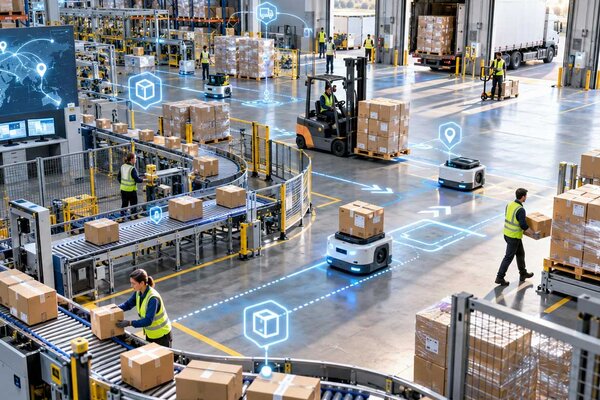
8 strategic technology trends in manufacturing and automation for 2026
2026-01-13 | 16 min Logistics and Manufacturing
Manufacturing Trends 2026 shows how the manufacturing industry is shifting from digital automation to autonomous operating models that are changing the management of production, logistics, and human labor.

The year 2026 marks the transition for the manufacturing sector from experimentation with Industry 4.0 technologies to their systematic, scalable implementation. After a period of pilot projects in the field of generative artificial intelligence, digital twins and advanced analytics, manufacturers' attention is shifting to the integration, automation and operationalization of decision-making processes across production.
The strategic priorities of manufacturing and IT teams are increasingly shaped by three interconnected pressures: a chronic shortage of skilled labor, increasing volatility in global supply chains, and tightening regulatory requirements around sustainability and carbon footprints. Isolated digitalization initiatives are gradually giving way to comprehensive architectures that directly impact the resilience, flexibility, and energy efficiency of manufacturing systems.
The convergence of physically deployed artificial intelligence, distributed computing models, and software-defined automation is fundamentally changing the nature of the manufacturing environment. Production management is shifting from passive data collection and visualization to autonomous process orchestration, in which systems actively participate in production planning, maintenance management, quality control, and logistics.
The following eight technology trends will shape the digital architecture of manufacturing enterprises in 2026-2027: the emergence of agent intelligence instead of static dashboards, the expansion of autonomous decision-making mechanisms, the use of simulations and digital twins as a standard before capital investments, the integration of advanced robotics, including humanoid systems, into everyday operations, and the shift of software to the role of the primary carrier of manufacturing flexibility.
Trend No. 1: Agentic Artificial Intelligence and Autonomous Operations
The transition from analytical support to autonomous production management
Artificial intelligence in manufacturing has undergone a gradual evolution from diagnostic analytics (what happened), through predictive models (what will happen), to prescriptive systems recommending optimal actions. However, 2026 brings another qualitative shift in the form of agentic artificial intelligence (Agentic AI). These are systems capable of independently perceiving the operational environment, planning procedures, making decisions, and executing actions without the need for constant human intervention.
Unlike so-called copilot solutions, which in previous years primarily functioned as tools reacting to explicit user inputs, agentic AI acts as an autonomous actor with a defined goal and clearly specified operational boundaries. In manufacturing environments, this means a transition from decision support to the direct execution of multi-step operations in planning, maintenance, logistics, and quality.
How does it work?
- Autonomous perception of operational state:
Agentic AI continuously processes data from production systems, sensors, MES, ERP, and other IT/OT sources. Based on this data, it creates an up-to-date production context, including the status of equipment, material availability, and capacities. - Real-time planning and decision-making:
The system evaluates possible development scenarios and selects optimal actions in line with defined objectives, such as minimizing downtime, meeting deadlines, or optimizing costs. - Interaction with external systems:
Modern agent frameworks enable AI to work with APIs, control systems, and databases. This includes adjusting production plans, initiating maintenance, or making changes in logistics flows. - Closing the decision loop:
Unlike traditional analytical tools, agentic AI not only identifies a problem but also implements corrective measures within predefined rules. - Multi-agent orchestration:
In practice, this involves cooperation among multiple specialized agents (e.g., maintenance agent, quality agent, logistics agent), whose activities are coordinated by a central orchestrator based on the current production situation.
What are the practical benefits?
- Significant reduction in reaction times:
Autonomous decision-making enables responses to failures, outages, or demand changes within seconds rather than minutes or hours. - Reduced burden on operators and management:
Routine decisions and operational interventions are handled by the system, while people focus on strategic management and optimization. - Higher operational stability:
Closed decision loops reduce the risk of human errors and inconsistent reactions in critical situations. - Better production adaptability:
The ability to autonomously replan production or logistics increases resilience to supply chain volatility and unforeseen events.
Why is this trend important?
In an environment of increasing complexity of production systems and a shortage of qualified workers, autonomous operations are becoming a necessary prerequisite for sustainable competitiveness. Agentic artificial intelligence addresses the long-standing “last mile” problem of automation by connecting analytics with execution.
For manufacturing companies, this represents a fundamental change in the management model—from manually coordinated processes to adaptive systems capable of independently optimizing operations. This capability will be one of the main differentiators between digitally mature and reactive manufacturing organizations in the coming years.
Trend No. 2: Physical AI and General-Purpose Humanoid Robots
The transition from rigid automation to a universal robotic workforce
The second major trend for 2026 is the rise of so-called physical artificial intelligence (Physical AI), i.e., AI models capable of understanding physical laws and actively interacting with the real world. Traditional industrial robots have long been limited to precisely defined, repetitive tasks in strictly controlled environments and, for safety reasons, separated from human workers. The development of physical AI fundamentally changes this paradigm.
In 2026, general-purpose humanoid robots and advanced collaborative systems powered by Vision-Language-Action (VLA) models will almost certainly enter real-world operations. These systems combine visual perception, natural language understanding, and the ability to perform fine motor tasks. The result is a robotic platform capable of adaptively performing diverse tasks in environments designed for humans, without the need for extensive reprogramming.
How does it work?
- Perception of the physical environment:
Robots use a combination of cameras, sensors, and so-called “world models” that allow them to understand space, objects, and their physical properties in real time. - Natural language understanding:
Vision-Language-Action models enable the interpretation of voice or text commands without the need for specific programming inputs. - Integration of vision and motor control:
Based on visual object identification, the system calculates precise motion trajectories and force moments required for manipulation, even in unstructured environments. - Flexible task switching:
Unlike traditional robotic arms, humanoid robots are not tied to a single workstation. They can move between workstations and change tasks based on software instructions. - Safe collaboration with humans:
The ability to perceive the surroundings and respond to unforeseen situations allows robots to work near people without protective cages or physical barriers.
What are the practical benefits?
- Addressing labor shortages:
Humanoid robots can take over physically demanding or monotonous tasks that are increasingly difficult to fill with human workers. - Higher automation flexibility:
A single robotic platform can replace multiple specialized automation solutions and adapt to current production needs. - Reduced integration costs:
There is no need for extensive modifications of the work environment or complex programming of every movement. - Improved workplace safety:
Deploying robots in risky and ergonomically unsuitable activities reduces workplace injuries and long-term health strain on workers.
Why is this trend important?
Physical AI shifts automation from narrowly specialized machines to a general-purpose robotic workforce. With the gradual decline in humanoid robot prices and increasing maturity of VLA models, the economic return of these solutions becomes comparable to the cost of human labor, especially in developed markets.
For manufacturing companies, this represents a fundamental change in their approach to automation. Instead of investing in rigid, single-function lines, it becomes possible to build adaptive production environments where robots dynamically move between tasks according to current needs. This flexibility will be one of the key factors of competitiveness of manufacturing operations in the coming years.
Trend No. 3: Software-Defined Automation (SDA) and Virtual PLCs
Separation of control logic from hardware and the end of vendor lock-in
Software-Defined Automation (SDA) represents one of the most significant structural changes in manufacturing since the introduction of programmable logic controllers in the 1960s. Its core principle is the separation of control software from proprietary hardware. Traditional PLC systems functioned for decades as closed “black boxes,” where software was inseparably tied to specific hardware platforms, significantly limiting flexibility, scalability, and innovation.
In 2026, SDA will move from experimental and pilot phases into real production deployments. Control logic is no longer tied to a specific controller but can run as a software layer on generic industrial PCs, servers, or edge devices. The concept of the virtual PLC (vPLC) becomes a practical tool for centralized control, infrastructure consolidation, and increased resilience of production systems.
How does it work?
- Separation of software from hardware:
Control logic is abstracted from the physical PLC device and operates as an independent software runtime. - Virtual PLC environment:
Control applications run as virtual instances (vPLCs) on industrial servers or edge platforms, similar to virtual machines or containers in IT infrastructure. - Containerization and standardization:
Control software can be distributed as a containerized application (e.g., Docker), enabling a unified approach to deployment, management, and updates. - Scaling and consolidation:
Multiple virtual PLCs can run on a single powerful server, reducing the number of physical devices on the factory floor. - Standards and interoperability:
Support for standards such as IEC 61499 and initiatives focused on vendor-independent automation enables portability of control code across platforms.
What are the practical benefits?
- Elimination of vendor lock-in:
Manufacturing companies are no longer tied to a single PLC hardware supplier and can combine solutions from different vendors. - Higher flexibility and resilience:
Control software can be moved to another hardware platform without major modifications, reducing risks associated with supplier outages. - Faster updates and changes:
Updates to control logic can be distributed centrally and remotely, without the need for physical intervention on devices. - Reduced hardware costs:
Consolidating control on a smaller number of servers reduces maintenance, energy, and space requirements in production.
Why is this trend important?
Software-defined automation fundamentally changes how production systems are designed and operated. Bringing principles known from the IT world into operational technology enables manufacturers to achieve greater agility, scalability, and technological independence.
The introduction of virtual PLCs opens the path to a “DevOps for manufacturing” approach, where control software can be rapidly tested, deployed, and updated across the entire production environment. In an environment of growing complexity of production lines and pressure for rapid innovation, SDA becomes a key prerequisite for long-term competitiveness.
Trend No. 4: Industrial Metaverse and Simulation-Based Engineering
A simulation-first approach as the new standard for designing production systems
The concept of the industrial metaverse has matured into a practical engineering discipline. In 2026, an approach referred to as Simulation-First Engineering is gaining traction, where products, production processes, and entire manufacturing facilities are first designed, simulated, and optimized in a physically accurate virtual environment, before capital is committed to physical assets.
This shift is driven by the integration of digital twins, advanced simulation tools, and game engine technologies with a high degree of physical accuracy. While in the past digital twins primarily served to monitor existing assets, the industrial metaverse focuses on predicting and validating future production states. The virtual environment becomes the place where decisions about production architecture are made before physical realization.
How does it work?
- Creation of a physically accurate digital twin:
Production lines, machines, robots, and infrastructure are modeled in a 3D environment, incorporating physical properties such as mass, friction, motion dynamics, and material flow. - Unified data format and interoperability:
Technologies such as Universal Scene Description (OpenUSD) enable the integration of CAD, BIM, simulation, and automation tools into a single consistent virtual environment. - Simulation of future operational states:
Virtual models are subjected to load scenarios, demand changes, failures, or production reorganization to identify bottlenecks and risks. - Hardware-in-the-loop (HiL) simulation:
The virtual factory communicates with real control software (PLC, vPLC), enabling testing of automation code before physical commissioning. - Virtual commissioning:
Software errors, collisions, and inefficient settings are identified and eliminated in the virtual environment, significantly reducing the time required for physical production startup.
What are the practical benefits?
- Reduced risk of capital investments:
Manufacturers can verify throughput, ergonomics, and stability of a new line without immediate investment in physical equipment. - Faster commissioning:
Virtual commissioning significantly shortens the time required for physical setup and tuning of production systems. - Better team collaboration:
Planning, production, and IT teams can work in a shared virtual environment, regardless of the geographical location of plants. - Performance optimization before deployment:
Identifying bottlenecks and collisions in simulation leads to higher throughput and stability after physical launch.
Why is this trend important?
The growing complexity of production systems and pressure for rapid introduction of new products increase the risk of poor investment decisions. Simulation-based engineering significantly reduces these risks by shifting decision-making into the virtual environment.
The industrial metaverse thus becomes a key tool for strategic production planning, production line optimization, and change management. For companies operating in environments with frequent product changes and high capital demands, a simulation-first approach represents an essential prerequisite for efficient and sustainable manufacturing.
Trend No. 5: Generative Design and Synthetic Data
Overcoming the limits of “small data” and accelerating the design of products and processes
With the growing deployment of artificial intelligence in manufacturing, the problem of so-called small data is becoming increasingly apparent. In well-managed production processes, defects and anomalies are relatively rare, which does increase production quality but also limits the availability of training data for AI systems—especially in visual quality inspection. A trend for 2026 is the systematic use of synthetic data and generative design as tools to remove this constraint.
Generating synthetic data makes it possible to create artificial yet physically and visually realistic datasets that faithfully mimic real production situations. In parallel, generative design is moving from optimizing individual components to optimizing entire production and workflow streams. Together, these approaches significantly shorten development cycles and increase the robustness of AI models as well as the products themselves.
How does it work?
- Generation of synthetic visual data:
Using procedural and generative techniques, photorealistic images of defects, surface flaws, or production variations are created under different lighting conditions and viewing angles. - Domain randomization:
AI models are trained on a broad spectrum of variations of a single phenomenon, including edge cases that occur rarely in real production or have not yet occurred at all. - Training and validation of quality models:
Synthetic data supplements or replaces real datasets, enabling the training of quality inspection models without having to wait for real failures. - Generative design of components:
An engineer defines design constraints (weight, strength, material, manufacturing technology), and the algorithm generates thousands of design variants optimized for the given criteria. - Generative optimization of processes:
In 2026, generative models are expanding into the design of manufacturing processes as well, such as toolpaths, part nesting strategies, or operation sequences, with the goal of minimizing waste and cycle time.
What are the practical benefits?
- Removing dependence on rare real-world data:
AI systems can be trained even in cases where real data is scarce or difficult to obtain. - More robust quality models:
Training on synthetic and extreme scenarios increases models’ ability to identify defects in real operations. - Reduced material and manufacturing costs:
Generative design often leads to significant reductions in weight and material consumption while preserving functional properties. - Faster development and prototyping:
Automated generation of designs shortens the time from concept to prototype and reduces the burden on development teams.
Why is this trend important?
In an environment of growing product complexity and pressure for rapid innovation, traditional approaches to design and AI model training are reaching their limits. Generative design and synthetic data make it possible to overcome these limits by moving part of development into a virtual and algorithmic space.
For manufacturing companies, this means democratization of advanced AI tools, faster R&D, and reduced dependence on the random occurrence of production defects. In 2026, these techniques become a key element of effective quality management, cost optimization, and sustainable product development.
Trend No. 6: Manufacturing Sustainability—from Energy to Suppliers
The transition from manual reporting to data-driven carbon transparency
In 2026, sustainability is definitively moving from the realm of voluntary initiatives into regulatory necessity. The implementation of mechanisms such as the EU Carbon Border Adjustment Mechanism (CBAM) and the Corporate Sustainability Reporting Directive (CSRD) forces manufacturers to systematically track and report not only their own emissions (Scope 1 and 2) but also emissions across the entire supply chain (Scope 3).
The scope and complexity of these requirements exceeds the capabilities of manual processing. A trend for 2026 is therefore the deployment of AI sustainability platforms that automate data collection, carbon footprint calculation, and the identification of emissions risks in real time. Sustainability thus becomes an integral part of a company’s operational and financial management.
How does it work?
- Automated collection of environmental data:
Platforms ingest data from energy meters, production equipment, MES and ERP systems, as well as from suppliers’ information systems. - Unified view of the carbon footprint:
Using DataOps approaches, heterogeneous data is normalized and consolidated into a unified model of the company’s environmental footprint. - Dynamic Product Carbon Footprint (Dynamic PCF):
Instead of static averages, the carbon footprint is calculated for a specific production batch based on the current energy mix and real supplier inputs. - Secure data exchange in the supply chain:
Cryptographically verifiable mechanisms enable the sharing of emissions data between partners without revealing sensitive business information. - AI-driven energy management:
AI models analyze consumption across all WAGES metrics (water, air, gas, electricity, steam), identify anomalies, and autonomously optimize equipment settings against production goals. - Automated Scope 3 analysis:
AI maps supplier data to relevant emission factors and identifies “hot spots” in the supply chain with the largest impact on the carbon footprint.
What are the practical benefits?
- Reduced administrative burden:
Automated reporting significantly shortens the time needed to prepare ESG reports and reduces the risk of errors. - Regulatory compliance:
Companies gain tools for continuous compliance with CBAM, CSRD, and future environmental mandates. - Direct reduction of energy costs:
AI-driven energy management makes it possible to optimize consumption and reduce costs by 5–30%, especially in energy-intensive operations. - Greater supply-chain transparency:
More accurate calculation of Scope 3 emissions enables better-informed decisions about suppliers and material inputs. - Stronger competitiveness:
The ability to document a verified carbon footprint for specific products becomes a decisive factor in winning contracts in regulated industries.
Why is this trend important?
In 2026, environmental performance is comparable to financial indicators. Companies that cannot transparently and accurately report their carbon footprint face not only regulatory penalties but also a loss of trust from business partners.
AI-driven sustainability enables a shift from retrospective reporting to active management of environmental impact. For manufacturers, this means not only meeting regulatory requirements, but also reducing costs, increasing operational efficiency, and gaining a competitive advantage in an increasingly strictly regulated global environment.
Trend No. 7: Extended “Connected Worker” and Digital Competency Management
Raising the knowledge threshold and stabilizing production in an era of workforce volatility
Despite the growing degree of automation, the human worker remains a key element of the manufacturing system. However, in 2026 manufacturing faces a combination of two long-term challenges: the retirement of experienced workers (“silver tsunami”) and high turnover among younger, less experienced employees. The trend is therefore the augmented connected worker (Augmented Connected Worker), whose capabilities are systematically strengthened by digital tools directly at the point of work.
The technological shift lies in moving from static work instructions to so-called knowledge automation. The goal is not to replace the worker, but to increase efficiency, reduce error rates, and shorten the time required to reach full productivity. Digital tools become carriers of operational expertise that was traditionally tied to individuals.
How does it work?
- Digital work instructions in process context:
Instead of static documents, workers receive dynamic, contextual instructions via tablets, mobile devices, or AR glasses. - Capturing and making core knowledge accessible:
AI systems document the know-how of experienced workers and transform it into standardized procedures available in real time. - AI-enhanced visual inspection (Step Check):
Mobile devices use computer vision to verify that steps were performed correctly and provide immediate pass/fail feedback. - Multimodal AI assistants:
Workers can ask questions by voice and receive answers as audio output or a visual overlay, enabling hands-free work during maintenance and assembly. - Digital competency management in MES:
Systems track certifications, performance, and current worker availability and dynamically assign tasks to those best suited to perform them. - Enforcement of standardized work:
Digital locks and integration with tools ensure that the process cannot continue until defined quality and safety conditions are met.
What are the practical benefits?
- Faster ramp-up to productivity:
Digital guidance reduces onboarding time for new workers by tens of percent. - Significant reduction in error rates:
Immediate feedback and enforcement of correct procedures prevent defects from moving into later production phases. - Preservation of know-how within the organization:
Core knowledge remains in systems even after experienced workers leave. - Greater workforce flexibility:
Digital competency management enables rapid redeployment of workers according to current production needs. - Higher employee engagement:
Modern, application-oriented tools increase satisfaction and acceptance of technology, especially among digitally native workers.
Why is this trend important?
Workforce instability and increasing complexity of production processes increase the risk of operational errors and outages. The augmented connected worker enables these risks to be managed systematically, without dependence on the individual experience of specific people.
In 2026, digital management of competencies and knowledge becomes an inseparable part of manufacturing architecture. Companies that can effectively combine the human factor with AI support gain greater stability, quality, and the ability to rapidly adapt production to changing conditions.
Trend No. 8: Autonomous Supply Chain
The transition from static planning to autonomous orchestration of material flow
In 2026, supply chains operate in an environment of permanent volatility caused by geopolitical tensions, climate events, and instability in global trade. The traditional “plan and execute” model, based on static assumptions and periodic recalculations, is no longer functional. The trend is autonomous supply chain orchestration, in which AI systems not only predict disruptions but actively coordinate the response across manufacturing, logistics, and warehouse management.
The key difference from earlier approaches is the shift from passive visibility to active adaptation. AI agents work with a digital twin of the supply chain and optimize material flow, inventory, and production capacity in real time. In this model, MES and WMS systems become the execution layer for autonomous decisions.
How does it work?
- Digital twin of the supply chain:
AI models create a dynamic graph of relationships between suppliers, production capacities, warehouses, transport routes, and customers, including time and capacity constraints. - Prediction and verification of scenarios:
Using reinforcement learning, the system continuously simulates “what if” scenarios (delivery delays, tariff changes, capacity outages) and evaluates their impact on the entire chain. - Autonomous decision-making by agents:
Contextual AI agents analyze the situation in real time and propose or carry out the “best next step”—for example, rerouting material flow, switching suppliers, or adjusting the production plan. - Dynamic supply management:
Connecting MES with WMS enables immediate responses to production deviations. Production changes are automatically reflected in material receiving, inventory allocation, and warehouse picking. - Autonomous inventory handling:
WMS systems provide accurate information on inventory availability, location, and turnover. AI uses this to decide on reallocating stock between warehouses, picking priority, or cross-docking scenarios. - Integration with suppliers and logistics:
Digital connectivity with suppliers enables rapid data exchange on material availability, transport capacities, and deadlines, reducing the reaction time of the entire chain.
What are the practical benefits?
- Fast response to disruptions:
Autonomous orchestration enables responses to disruptions within minutes instead of days. - Optimization of inventory and working capital:
Precise linkage of production, warehouses, and logistics reduces excess stock without jeopardizing production continuity. - Higher efficiency of warehouse operations:
AI-driven WMS systems optimize picking, movements, and order prioritization in line with current production needs. - Increased productivity of planning teams:
AI takes over routine decision-making and filters noise, enabling planners to focus on strategic exceptions and partner relationships. - Greater supply-chain resilience:
The combination of MES, WMS, and AI agents creates an adaptive system capable of absorbing external shocks without major operational impacts.
Why is this trend important?
In an environment of constant volatility, the supply chain becomes one of the main factors of competitiveness. Autonomous orchestration shifts management from reactive firefighting to proactive optimization of material and information flows.
Integrating AI with MES and WMS systems transforms the supply chain from a cost center into a strategic tool. Companies that can align manufacturing, warehousing, and logistics within a single autonomous control model in 2026 gain a significant advantage in speed, flexibility, and the ability to operate long-term in an unstable global environment.
Continuous transformation of manufacturing systems
In 2026–2027, the manufacturing industry is moving from the phase of experimenting with generative AI into a period of disciplined, operations-oriented automation. The common denominator of all identified trends is the gradual convergence of previously separate domains: IT and OT are being connected through software-defined automation, design and manufacturing are being linked through simulations and digital twins, and human–machine collaboration is being transformed thanks to physical AI and augmented digital tools.
A decisive success factor becomes the quality of the data foundation and the ability to adapt the existing manufacturing environment. Most 2026 technologies are applicable in brownfield operations through software layers, edge computing, and gradual architecture modernization. The winners will not be the companies with the highest degree of automation, but those that can build adaptable operating models, combine autonomous systems with augmented human capabilities, and systematically turn technological potential into operational resilience and competitive advantage.