8 logistics trends that will impact warehouse and supply chain efficiency in 2026
2025-10-14 | 16 min Logistics and Manufacturing
Logistics Trends 2026 show that warehouses and supply chains are in for a major transformation. Automation, data analytics, predictive management, and new approaches to human resources are changing the efficiency, flexibility, and sustainability of logistics processes.

The year 2026 brings a fundamental transformation to the world of logistics and warehouse management. We are no longer facing gradual changes, but a dynamic environment where climate crises, geopolitical tensions, and exponential technological progress create conditions that many describe as chaos.
However, this apparent chaos is, in fact, a catalyst for unprecedented innovation and opportunity for those ready to adapt. The growing customer demand for instant, accurate, and fully transparent deliveries is pushing traditional logistics practices into the realm of unsustainable models and forcing companies to rethink their operational strategies from the ground up.
The key to success in this new era is not gradual improvement, but a comprehensive transformation built on three interconnected pillars:
- Scalable automation
- Predictive analytics
- A new synergy between humans and technology
These elements are no longer optional—they are essential for maintaining competitiveness.
- Intelligent and scalable automation:
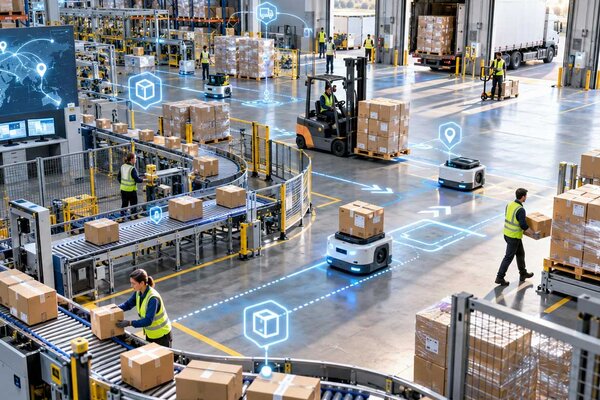
Forget the idea of rigid and unchanging automated lines. The new standard today is modular and flexible solutions such as autonomous mobile robots (AMRs).
These technologies allow companies to dynamically adapt their operations, efficiently handle seasonal peaks, and scale capacity in line with business growth.
- Data literacy and predictive management:
At the core of all modern processes lies data. We are shifting from reactive problem-solving to predictive management—where, through data analysis and artificial intelligence, we can forecast demand, plan equipment maintenance before failures occur, and optimize inventory levels with unprecedented accuracy. Decision-making based on facts rather than intuition is becoming the new norm. - The new role of humans:
At the heart of this technological revolution, the human being remains essential—though their role is fundamentally changing. The manual worker becomes a strategic operator, analyst, and innovator who manages and optimizes technological processes. It is precisely in the combination of human creativity and analytical thinking with the performance and precision of automated systems that the greatest potential for efficiency gains lies.
These circumstances affect not only what happens inside the warehouse. Their influence extends to the optimization of the entire logistics network, including key middle-mile processes and the advancement of the circular economy through sustainable reverse logistics.
Trend No. 1: Scalable Automation
Flexibility as the New Operational Standard
The era when warehouse automation was synonymous with massive, costly, and rigid systems has come to an end. Modern logistics—driven by ever-changing e-commerce demands and global fluctuations in supply and demand—requires a completely new approach.
Technology can no longer be seen as a one-time investment in fixed infrastructure, but as a dynamic ecosystem that must grow and adapt alongside the company and its needs.
Scalable automation provides the answer to this need for agility, shifting the focus from rigid solutions to intelligent and modular mobile robotics. The core idea is to make internal material transport more efficient—minimizing the unproductive movement of operators and maximizing the movement of goods themselves. This concept is embodied in the “goods-to-person” principle, which fundamentally changes warehouse operations.
At the heart of this transformation are Autonomous Mobile Robots (AMRs), representing a generational leap from older Automated Guided Vehicles (AGVs). While AGVs rely on fixed routes such as magnetic tapes or guiding wires, AMRs navigate autonomously using advanced sensors, mapping, and artificial intelligence.
This capability allows them to adapt in real time to changes in the warehouse environment. For example, if an aisle is temporarily blocked by a pallet or equipment, an AMR can detect the obstacle and automatically plan an alternative route, avoiding unnecessary downtime.
In practice, this technology is used for dynamic transport of goods between zones, for example, from picking areas to packing stations. In e-commerce warehouses, robots often bring entire shelves directly to the operator, who remains stationary and focuses solely on value-added tasks such as order completion. This dramatically reduces the time needed to pick a single order and significantly increases overall warehouse throughput.
However, intelligent robot movement wouldn’t be possible without centralized control. This is where a modern Warehouse Management System (WMS) comes into play — the “brain” of the operation. The WMS processes, in real time:
- incoming order data,
- inventory status, and
- the location of robots and employees.
Based on this information, it can optimize routes, assign priorities to tasks, and dynamically distribute work between humans and robots to ensure balanced workload and maximum efficiency — even during extreme peaks.
Beyond boosting productivity, this operational model also delivers major benefits for employees. Robots take over the most physically demanding tasks, such as handling heavy pallets or constantly moving goods, thereby reducing the risk of workplace injuries and employee fatigue.
Workers can then focus on more complex, quality-driven activities such as quality control, packing fragile items, or personalizing shipments—areas where human judgment remains irreplaceable. Implementation, however, requires careful preparation, including initial investment, seamless integration with existing IT systems, and comprehensive staff training for new workflows and human-robot collaboration.
Why is this trend important?
Integrating scalable automation is not merely an operational upgrade—it’s a strategic necessity. It represents a key step toward fully digital, agile logistics processes capable of adapting to market volatility.
It enables companies not only to increase efficiency and reduce operational costs but also to create safer and more ergonomic workplaces for employees. Ultimately, it’s about the ability to dynamically adjust capacity and processes to any situation.
Trend No. 2: Collaboration Between Technology and the Human Factor
The Human as the Guardian of Quality
As automation in logistics advances, a common misconception arises — that the goal is to completely replace the human factor. In reality, the situation is far more complex and strategic. Effective warehouse management does not depend on choosing between humans or machines, but on finding the optimal balance and synergy between them.
Automated systems such as AS/RS (Automated Storage and Retrieval Systems) or shuttle systems are undeniably pillars of efficiency, enabling:
- continuous processing of large order volumes,
- higher productivity, and
- lower operational costs.
Yet it is the human who remains the guarantor of quality, flexibility, and continuous improvement.
The role of warehouse employees is not disappearing—it is being transformed. Workers are shifting from performing repetitive manual labor to taking on strategic and technical roles, where human skills are irreplaceable. This change requires entirely new competencies and skill sets.
The economic reality of automation is one of the main reasons the human factor remains vital. Investments in advanced technologies are substantial, and their return depends directly on how long and efficiently those systems are in use.
For automation to be economically viable, machines must operate for as much of the day as possible—ideally around the clock. This naturally creates a need for qualified personnel to be present during all shifts, including nighttime.
Although technologies like humanoid robotics or virtual reality may one day enable remote supervision, for now, physical human presence remains essential.
The employee’s role is no longer to carry boxes but to ensure the seamless operation of automated systems, troubleshoot technical issues, and perform preventive maintenance to avoid costly downtime.
Thus, warehouse employees are becoming technical supervisors and analysts. Using data tools and WMS systems, they constantly monitor system performance, analyze key performance indicators (KPIs), and identify opportunities for improvement based on data insights.
Moreover, employees play an irreplaceable role in process innovation and optimization. Their hands-on experience allows them to identify nuances and inefficiencies that even the most advanced technologies cannot detect independently.
The resulting synergy delivers measurable benefits. The combination of technological speed and precision with human oversight and problem-solving leads to faster, more reliable order fulfillment.
Automated technologies handle routine and physically demanding tasks, improving workplace safety while freeing up employees to focus on more strategic work. Warehouses managed in this way can flexibly adapt to market changes and scale capacity during seasonal peaks without massive temporary hiring.
Why is this trend important?
Success in logistics won’t belong to the companies with the most robots, but to those that best integrate technology with the unique capabilities of their people. This combination creates a highly efficient, safe, and flexible operating model—essential for adapting to the market’s dynamic demands.
Investment in automation is, therefore, inseparable from investment in developing and retraining the people who will manage and improve it.

Trend No. 3: Data Literacy
Decisions Based on Facts, Not Intuition
In today’s logistics, there is no longer room for decisions based on assumptions or incomplete information. Data literacy is becoming the cornerstone that supports all other trends — from automation to predictive management.
It represents a fundamental shift from intuition-based management to strategic decision-making that is fully grounded in facts and data. Companies that ignore this trend risk not only losing efficiency but also falling behind competitors who are already actively using data to gain strategic advantages. Data analysis is no longer an optional add-on — it has become a vital prerequisite for business survival and growth.
The role of a data analyst and their team can best be compared to a company’s immune system. This system continuously monitors the “health” of the entire logistics operation, scans vast amounts of data, and actively detects anomalies, hidden patterns, and potential threats.
In practice, this means that an analyst can use historical data and artificial intelligence to predict future demand, helping to prevent costly situations such as excess inventory or, conversely, shortages of key goods.
They can identify bottlenecks in the supply chain before they cause serious problems and propose solutions to eliminate them. This ability to foresee risks — whether they stem from external factors disrupting the supply chain or from internal inefficiencies — enables companies to respond proactively and adapt their strategies. The importance of this approach is confirmed by an MIT study showing that companies with advanced data analytics managed the COVID-19 crisis 40% better.
The benefits of data analytics directly translate into improved financial results. Companies using advanced analytical applications can reduce their distribution costs by 10 to 20 percent. Beyond operational optimization, data analysis also enables a deeper understanding of customer needs and purchasing behavior.
These insights are invaluable for the personalization of services and marketing strategies, leading to increased customer satisfaction and loyalty. However, as the importance of data grows, the issue of cybersecurity becomes increasingly prominent.
Digitalized warehouses and interconnected supply chains are becoming targets of attacks — for instance, ransomware that can cripple an entire operation. Protecting sensitive customer and operational data, securing backup systems, and complying with strict regulatory requirements such as GDPR are therefore integral parts of every data strategy.
Why Is This Trend Important?
Data literacy is becoming the central nervous system of modern logistics. It transforms raw data into strategic intelligence that enables companies to make faster, more accurate, and better-informed decisions at all management levels.
In today’s dynamic environment, the ability to see, understand, and predict based on data represents a crucial competitive advantage. It is the difference between passively reacting to changes and actively shaping your own future.
Trend No. 4: Predictive Management
From Firefighting to Foreseeing the Future
The cornerstone of advanced logistics is a fundamental shift in thinking — a move from reactive management to predictive control. The reactive approach, which focuses on solving problems only after they occur, is not only inefficient in today’s fast-paced and competitive environment but also extremely costly.
Unplanned downtimes of key equipment — such as conveyor systems — can cost five to ten times more than planned maintenance and lead to disruptions in the entire order or supply flow. Predictive management turns this model upside down.
Instead of waiting for a breakdown, it uses advanced technologies — such as IoT sensors and machine learning — to continuously analyze data and forecast future events. In practice, this means that distribution centers, for example, use vibration sensors to schedule bearing replacements two to three weeks before a predicted failure, thereby completely eliminating unexpected stoppages. However, this approach extends far beyond maintenance.
The power of predictive analytics is fully revealed in inventory and warehouse space optimization. Advanced WMS systems use predictive analytics to dynamically position fast-moving goods as close to packing stations as possible and adjust storage density based on the predicted turnover frequency.
More sophisticated WMS systems can also combine historical sales data with more than fifteen external variables — including economic indicators and weather — to forecast future demand with 20–35% higher accuracy. These capabilities also extend to workforce management, where labor needs can be predicted with up to 90% accuracy three weeks in advance, based on the analysis of historical order patterns and planned marketing campaigns.
However, the true potential of predictive management is unlocked only when its scope expands beyond a single warehouse to encompass the entire supply chain. This is where the End-to-End (E2E) visibility concept comes into play — enabling real-time data collection and analysis across all points of the chain, from raw material suppliers through production and transportation to delivery to the end customer. Such a holistic view allows companies to anticipate not only internal but also external risks.
Why Is This Trend Important?
Predictive management transforms the supply chain from a reactive to a proactive and strategic asset. It allows companies to maintain control in unstable environments, minimize risks before they occur, and seize opportunities faster and more efficiently than the competition.

Trend No. 5: Intelligent Orchestration of Warehousing and Supply
When the WMS Controls Every Step
Advanced Warehouse Management Systems (WMS) are no longer passive tools for recording inventory. Today, they are transforming into intelligent control centers, whose ability to actively and dynamically manage all processes in real time is directly proportional to their level of configurability.
It is precisely this high degree of configurability and rule customization that enables the transformation of a warehouse from a static space into a living, continuously self-optimizing organism. This trend is most evident in advanced management of picking processes, which are essential for handling large volumes of diverse orders — a typical challenge in e-commerce logistics.
The goal is to eliminate unproductive movements and downtimes that often cause errors and reduced efficiency. The foundation lies in the logical division of the warehouse into smaller, specialized zones. These zones are defined based on various criteria — such as product type, order frequency, or specific handling requirements — with each zone assigned to specific operators or autonomous robots.
On top of this structure, the intelligent WMS builds its dynamic control logic. The system, integrated with IoT sensors and data processing tools, continuously monitors and analyzes the flow of orders in real time. Based on the current situation, it dynamically allocates resources where they are most needed.
For example, if one zone experiences an unexpected increase in workload, the system immediately detects it and autonomously reallocates available workers or robots to relieve the overload, preventing bottlenecks and maintaining operational flow. But the control goes even further.
The WMS analyzes the movements of workers and robots, identifies duplicate or unnecessary routes, and actively eliminates them. It can also distribute tasks based on type — for instance, assigning heavy or bulky items to robots while delegating smaller and more precision-demanding orders to human operators.
Thanks to continuous performance monitoring across all zones, the system can automatically adjust planning and propose process changes to achieve maximum efficiency. The results of such an intelligent approach are both measurable and significant.
Dynamic resource allocation and optimized routing lead to faster order processing — in practice, reducing dispatch times by up to 30%. Minimizing downtime and eliminating overlapping routes also significantly decreases picking errors, which is critical for maintaining customer satisfaction.
This ensures optimal use of all available resources, allowing companies to flexibly reallocate capacity — for instance, during seasonal sales — without increasing staff levels. Ultimately, workflow optimization leads to a noticeable reduction in operational costs for both energy and personnel.
Why Is This Trend Important?
Intelligent process management transforms the WMS from a record-keeping tool into a proactive optimization instrument. This trend is the key to maintaining competitiveness in a sector where clients expect flawless and nearly instantaneous order and material deliveries. It not only dramatically increases productivity and accuracy but also provides the flexibility and agility essential for modern logistics operations in a dynamic market environment. It marks the shift from static management to dynamic orchestration, turning the warehouse into a true competitive advantage.
Trend No. 6: Middle-Mile Optimization
The Hidden Key to Fast Delivery
In discussions about efficient logistics, the greatest attention is often given to warehouse innovations or “last-mile” productivity — the final delivery of goods to the customer. However, the real key to the success and efficiency of the entire supply chain increasingly lies in optimizing the middle mile.
This phase represents the logistical bridge between central distribution centers and local warehouses, city hubs, or pickup points — and it has a decisive impact on total costs, delivery speed, and reliability.
It is precisely in this phase that it is determined whether fast and cost-effective last-mile delivery is even possible. This trend is particularly critical in dynamic sectors such as e-commerce and fast-moving consumer goods (FMCG), where customers expect near-instant product availability. Proper management of the middle mile is therefore no longer just an operational task but a strategic priority.
Optimization of this phase rests on several pillars. The first is the physical design of the distribution network itself. The traditional model of a single massive central warehouse is no longer sufficient. Middle-mile efficiency begins with the strategic placement of distribution centers as close as possible to key consumer areas.
There is a shift toward a decentralized model, where smaller regional centers serve local pickup points. This approach not only shortens transportation distances and reduces costs but also enables much faster responses to local demand.
Above this physical infrastructure, however, must stand intelligent technological management. A crucial role is played by Transportation Management Systems (TMS), which can dynamically plan routes in real time. These systems analyze factors such as traffic density, road conditions, and load volume to generate the most efficient transport plan — which is critical, for example, in fresh food delivery, where even slight delays can lead to spoilage.
An equally important role is played by the Warehouse Management System (WMS), which acts as a coordination center. The WMS integrates and processes data from across the entire chain, enabling precise inventory tracking across all locations and fast decision-making about which point is most efficient for dispatching a particular order or shipment. This minimizes downtime and optimizes inventory transfers between centers.
The future of the middle mile will also be shaped by growing standardization and specialization. This may manifest in the creation of facilities specialized by product type and in the expansion of pickup box networks. It is expected that, beyond ordinary goods, we will see the rise of specialized refrigerated or frozen pickup lockers — particularly with the growth of the food e-commerce segment.
The results of these optimization efforts are evident: significant reductions in logistics costs (up to 15%), faster deliveries to customers, and — not least — a reduced environmental footprint thanks to more efficient use of transport capacity.
Why Is This Trend Important?
Middle-mile optimization is a necessary response to the rising demand for online shopping and increasingly shorter delivery times. Efficient management of this logistics phase not only delivers major cost savings but also directly impacts customer satisfaction and the sustainability of the entire supply chain.
Trend No. 7: Circular Supply Chain
The Future of Logistics Lies in the Return
The traditional linear supply chain model — based on the simple principle of “produce – use – dispose” — is becoming unsustainable in today’s world. Increasing pressure from customers, stricter regulatory requirements, and, not least, economic realities are forcing companies to rethink their approach to resources and waste.
The answer to these challenges is a shift toward a circular model, which integrates reverse logistics, eco-friendly materials, and resource reuse into a single closed loop. At the center of this transformation stands packaging material, one of the most visible outputs of logistics operations and simultaneously a major source of innovation potential.
The goal is to reduce waste, optimize costs, and build a more sustainable and resilient supply chain. This approach rests on two main pillars:
- implementation of returnable packaging, and
- use of eco-friendly, easily recyclable materials.
Returnable packaging systems — such as reusable pallets and plastic crates — have long been a standard in the B2B segment for their practicality and cost efficiency. The real challenge, and at the same time the greatest opportunity, lies in their adoption in the B2C segment, especially in e-commerce.
It is becoming evident that an increasing number of consumers are willing to invest time and effort into returning packaging into circulation, supported by successful campaigns such as deposit-return systems for beverage containers. However, implementing such a system in e-commerce requires precise mastery of reverse logistics.
In addition to solving the collection of packaging from consumers, it is necessary to design efficient processes for subsequent transport and cleaning. The packaging itself must be designed to be durable, easily storable, and, most importantly, collapsible to reduce its volume for efficient return transport.
Where reuse is not possible, the second pillar comes into play — the use of eco-friendly materials. This includes transitioning to certified sustainable cardboard packaging or replacing plastic stretch films with paper alternatives that are easier to recycle.
Managing these complex reverse flows would be unthinkable without robust technological support. Advanced Warehouse Management Systems (WMS) play an invaluable role in overseeing the entire circular chain.
They enable real-time tracking of returnable packaging, monitoring of recycling processes, and efficient planning of reverse logistics. Thanks to WMS systems, logistics managers always have a clear overview of where the packaging is located and can effectively coordinate its return and further use.
The benefits of this approach are threefold:
- Cost reduction through decreased need for single-use materials,
- Improved brand image among customers who increasingly favor sustainable companies, and
- Enhanced environmental footprint and compliance with environmental regulations.
Why Is This Trend Important?
The transition to a circular model is not merely a matter of environmental responsibility — it represents a fundamental business strategy. It allows companies to innovate their logistics processes and adapt to the expectations of both customers and legislation.
In an era of rising raw material prices and growing pressure to reduce waste, the ability to effectively manage reverse logistics becomes a significant competitive advantage.

Trend No. 8: Flexibility and Talent Management in Logistics
Data-Driven Workforce Management
While technological transformation in warehouses is advancing by leaps and bounds, an equally crucial battle is being fought in the field of human resources. Modern logistics management faces enormous challenges:
- a chronic shortage of qualified labor,
- rising wage costs, and
- extreme demand volatility.
This situation makes the traditional, rigid model of workforce management obsolete and forces companies to seek new, far more flexible and strategic approaches.
Success no longer depends solely on how efficiently a company manages its goods and inventory — but also on how well it can attract, motivate, develop, and flexibly deploy its people. The human factor thus becomes not only a key resource but also a potential bottleneck in the entire operation.
The answer to these challenges lies in adopting a data-driven approach to workforce management, enabled by Labor Management Systems (LMS). Just as WMS optimizes the movement and storage of goods, LMS optimizes the deployment and performance of the workforce.
These systems go far beyond simple attendance tracking. They allow monitoring of individual and team productivity in real time, comparing it to predefined standards, and identifying not only top performers but also those who require additional training.
With access to precise data, companies can implement fair and motivating reward systems that directly link pay to performance. LMS provides managers with valuable insights for effective shift planning, ensuring that the right number of employees with the right skills are always in the right place at the right time.
However, technology solves only part of the problem. In an environment where warehouses compete for talent not only among themselves but also with other industries, a strong strategy for attracting and retaining qualified employees becomes essential.
Warehouses are transforming into technological hubs, and therefore must offer more than just wages. This includes investing in safe and ergonomic working conditions, modern equipment, and, most importantly, clearly defined career paths.
Opportunities for retraining and career advancement — for example, from warehouse operator to automation technician or data analyst — are among the most powerful tools for retaining talent and maintaining a qualified workforce.
At the same time, to handle extreme demand peaks such as holiday sales, the use of flexible employment models has become essential. Building a network of reliable temporary workers, often through digital platforms in the style of the gig economy, enables companies to dynamically scale their capacities and adjust labor costs to current needs — without having to maintain a year-round workforce sized for maximum load.
Why Is This Trend Important?
In an era where access to automation and software solutions is becoming increasingly widespread, the true competitive advantage is shifting toward the human factor. A company’s ability to attract, develop, and flexibly manage a skilled and motivated workforce will be just as important as its investments in robotics and automation.
Mastering workforce management is no longer merely a supporting HR function — it is becoming an essential component of sound operational strategy.